1st order properties
Wiegand, Getzin, Hesselbarth
Please find the introduction slides here. If you want to print the point pattern to flip coins on it, you can find a DIN A4 .pdf-file here. Addtionally, there is an Excel template, you can find here.
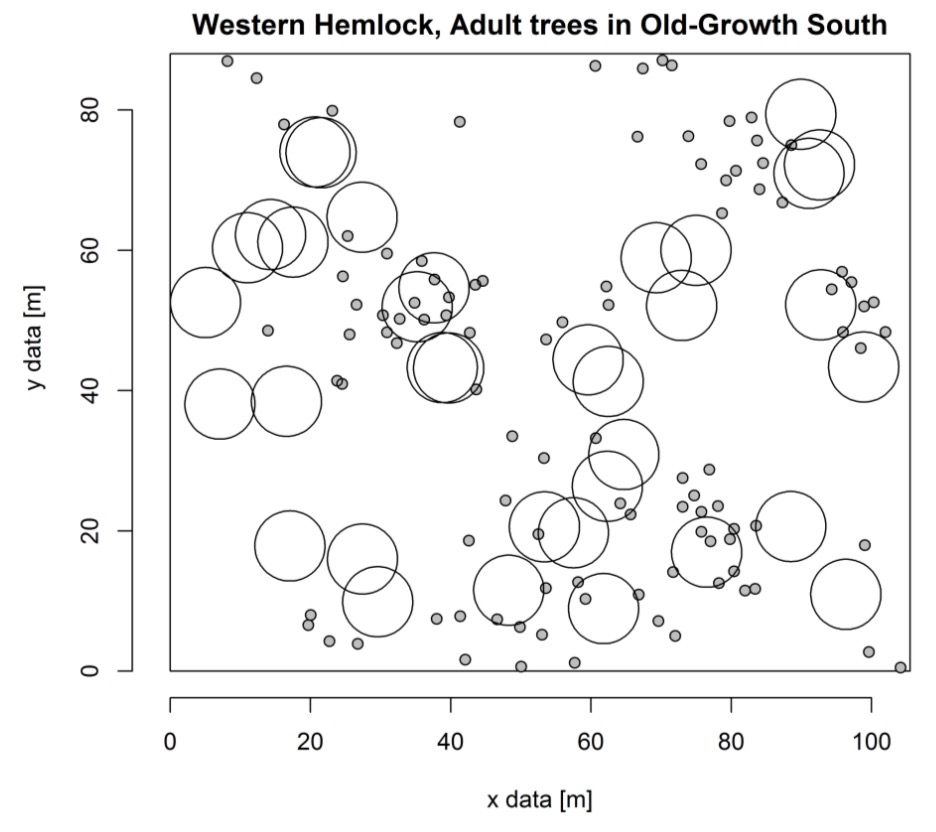
In case you do not want to print the pattern and actually flip a coin, you could use the following code to “simulate” a coin flip.
# function to virtually flip coins
flip_coin <- function(pattern, n = 50, radius = 5) {

  # loop through number of coin flips
  vapply(X = 1:n, FUN = function(x) {

  # random coord within plot as coin center
  coin_center <- spatstat.random::runifpoint(n = 1, win = pattern$window)

  # calculate coords of circle around center using radius
  coin_x <- sin(seq(0, 2 * pi, length.out = 250)) * radius + coin_center$x
  coin_y <- cos(seq(0, 2 * pi, length.out = 250)) * radius + coin_center$y

  # convert circle to window object
  coin_owin <- spatstat.geom::owin(poly = cbind(rev(coin_x), coin_y))

  # sum of points within window
  sum(spatstat.geom::inside.owin(x = pattern, w = coin_owin))
  }, FUN.VALUE = numeric(1))
}
You can use the resulting count of events within each virtual coin
flip to fill the Excel template. Have a look at different
radius arguments, to analyse various sizes of the “moving
window”.
library(dplyr)##
## Attaching package: 'dplyr'## The following objects are masked from 'package:stats':
##
## filter, lag## The following objects are masked from 'package:base':
##
## intersect, setdiff, setequal, unionlibrary(spatstat)## Loading required package: spatstat.data## Loading required package: spatstat.univar## spatstat.univar 3.1-5## Loading required package: spatstat.geom## spatstat.geom 3.6-1## Loading required package: spatstat.random## spatstat.random 3.4-3## Loading required package: spatstat.explore## Loading required package: nlme##
## Attaching package: 'nlme'## The following object is masked from 'package:dplyr':
##
## collapse## spatstat.explore 3.6-0## Loading required package: spatstat.model## Loading required package: rpart## spatstat.model 3.5-0## Loading required package: spatstat.linnet## spatstat.linnet 3.4-0##
## spatstat 3.5-0
## For an introduction to spatstat, type 'beginner'# read x and y coords of data
douglas_fir <- read.table(file = "Data/DouglasFir_Adult_vs_Seedling_OGN.txt",
sep = ';', header = TRUE)
# filter for only living trees
douglas_fir <- dplyr::filter(douglas_fir, mark == 1)
# convert to spatstat point pattern object
douglas_fir_ppp <- spatstat.geom::ppp(x = douglas_fir$x, y = douglas_fir$y,
window = spatstat.geom::ripras(x = douglas_fir$x,
y = douglas_fir$y,
shape = "rectangle"))
# create 35 coin flips
flip_coin(pattern = douglas_fir_ppp, n = 35)## [1] 1 2 0 2 4 1 0 0 0 0 0 1 0 0 2 3 0 1 0 0 0 0 2 0 0 1 1 0 0 0 1 0 2 0 2